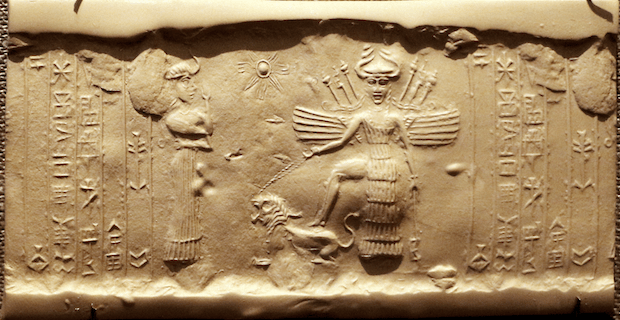
Entering the surgical theater for a transcatheter aortic valve replacement (TAVR), I found myself thinking of the ancient Sumerian myth of Inanna and her descent into the underworld. In the story, she travels to nether world bowed and stripped of all her power—naked before forces beyond her control.
Just before the anesthetic was administered, I mentioned the myth to the attending physicians. One of them asked for more details. I said that it is a story every surgeon might recognize, because in some sense it is enacted each time a scalpel is applied. I offered a brief telling, and one physician quietly pulled out her phone to make a note, intending to to look it up later.
That moment opened a much older memory.
The first time I heard the story was during an all-night bardic circle with a small pagan group in the hills of Mendocino County. Early in the evening, we had taken psilocybin mushrooms, and as the night deepened, the circle unfolded in a kind of luminous intensity—songs, storytelling, and moments of unexpected healing was summoned.
In that predawn moment on the threshold of time, as darkness loosened its hold and mist drifted over the hills, a woman emerged from the spectral haze. Wrapped in a black hooded cloak, she stood before us and began to speak the myth of Inanna, Queen of Heaven. As she spoke of descent and return, I recognized that I, too, have gone down and come back changed. That predawn encounter no longer feels distant or unreal; it’s become a quiet inner compass, shaping how I move through my days, how I make choices, and how I accompany others through their own crossings.
The myth itself dates back to roughly 1900–1600 BCE.
Inanna, the great goddess and Queen of Heaven, sets her intention to descend into the underworld, the realm of her sister Ereshkigal, Queen of the Dead. As she passes through each of the seven gates, she is required to remove an article of power—her crown, her scepter, her breastplate—until she stands completely stripped. At each threshold she protests, and each time the guardians reply:
“Hush, Inanna. The ways of the underworld are perfect and must not be questioned.”
At last, she enters the realm of her sister bowed low and naked, and she is judged, struck down, and her corpse is hung on a hook like a piece of meat.
Meanwhile, her faithful servant Ninshubur seeks help from the gods. Most refuse, but Enki, the god of wisdom, agrees to intervene. He creates two small, androgynous beings—Kurgarru and Kalaturru—and sends them into the underworld.
There they encounter Ereshkigal in the throes of grief and labor. Instead of trying to fix or oppose her suffering, they mirror it back to her, echoing her cries: “Oh my stomach, oh my spleen.” Their simple, compassionate presence moves her. In gratitude, she offers them a gift.
They ask for the body hanging on the hook.
Through this act, Inanna is restored to life and eventually returns to the upper world, which has languished in her absence.
What has stayed with me most over the years is that repeated injunction at the gates:
“Hush, Inanna. The ways of the underworld are perfect and must not be questioned.”
To enter surgery is, in its own way, to enter such a realm—to go bowed, exposed, and surrendered to forces and authorities beyond oneself. Whatever else we may believe, there is a profound act of trust in that passage. A stripping away. A crossing over.
And perhaps, like Inanna, a return.
By the way, my return from the TAVR surgery was successful and I’m recovering well.